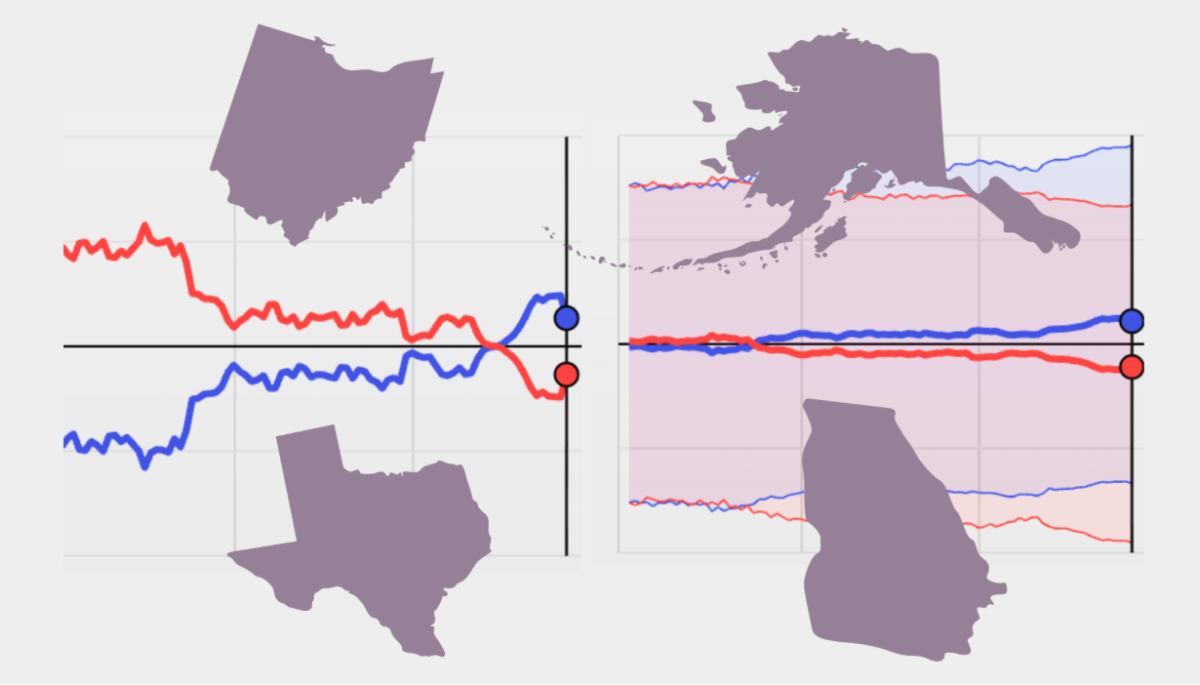
Left: The Economist’s projections on the likelihood of control in the Senate
Right: The Economist’s projections of median seats won in the Senate
As we approach the 500-day mark of the second Trump Administration, its biggest test yet is looming. The 2026 Midterms will decide how the next 2 years of the administration will go: either a green light to their agenda, or a strict reprimand for change.
Currently, according to aggregations, Democrats have maintained a 6 to 8 point lead over Republicans in polling. This already exceeds Democrats’ performance in 2018, a midterm cycle famous for a 41-seat Democratic pickup in the House, even though they weren’t able to win the Senate.
But how will this favorable public opinion be translated when it comes to election day?
The House
Democrats are nearly certain to win control of the House, with The Economist projecting a 92% chance and a median victory of 29 seats for Democrats. Recently, however, the House has been the center of redistricting battles, propelled last July when President Trump encouraged Texas Republicans to redraw their congressional maps in their favor. This set off nearly a year of redistricting and counter-redistricting as both parties scrambled to strategically sketch district boundaries to favor them. This battle continues today, with Republicans sitting at a +3 net seat gain for the next election purely from redistricting, and more maps are being considered.
Evidently, it’s unlikely that Republicans will be able to draw their way to a House majority, as that would need dozens of redistricting attempts, at a minimum.
The Senate
But what Democrats really need is to win the Senate. Control of the Senate would allow Democrats to block nominations from the president, launch investigations, and, with control of the House, even begin legislating their agenda.
Democrats currently have 47 seats (including 2 independents who caucus with them) in the Senate, which must be raised to 51 to secure control. Even a 50-50 tie wouldn’t be enough, as Vice President JD Vance would cast his tiebreaking vote for Republicans.
To start, Democrats need to hold a Senate seat in both Michigan and Georgia. Jon Ossoff, the Democratic Georgia Senator up for reelection, famously barely emerged victorious in his 2020 election, where he trailed behind by around 2 points. But due to a majority being required for election, runoff races were held, where Ossoff won by just approximately 1 percent. This cycle, Democrats have pulled a small lead over Republicans in both races, leading by around 5 points.
But the race gets heated as Democrats must then gain another 4 seats.
One, North Carolina, is expected to easily go to Democrats, who are currently leading by 6-8 points on average.
Another, which may be surprising, is Maine, which is expected to lean Democratic. Although Maine is in the commonly liberal region of New England, they have consistently elected Republican Senator Susan Collins since 1996. Democrats hope fresh-faced candidate Graham Platner will be able to appeal to the electorate, contrasting his fresh leadership with Collins’ 73 years of age.
For the last two needed to flip the Senate, Democrats have three states to choose from: Ohio, Texas, and Alaska.
In all three, Democrats and Republicans have been trading blows, and neither party has been able to pull a consistent lead in polling. For instance, in Texas, Democratic James Talarico has been able to pull a small lead over Republican Ken Paxton and has been making great strides. However, he’s still facing an uphill battle, attempting to win a state that hasn’t elected a Democratic Senator since 1988 or voted for a Democratic President since 1976.
Overall, Democrats are strongly favored to win the House despite redistricting attempts, but must focus on winning races that haven’t been competitive for decades.