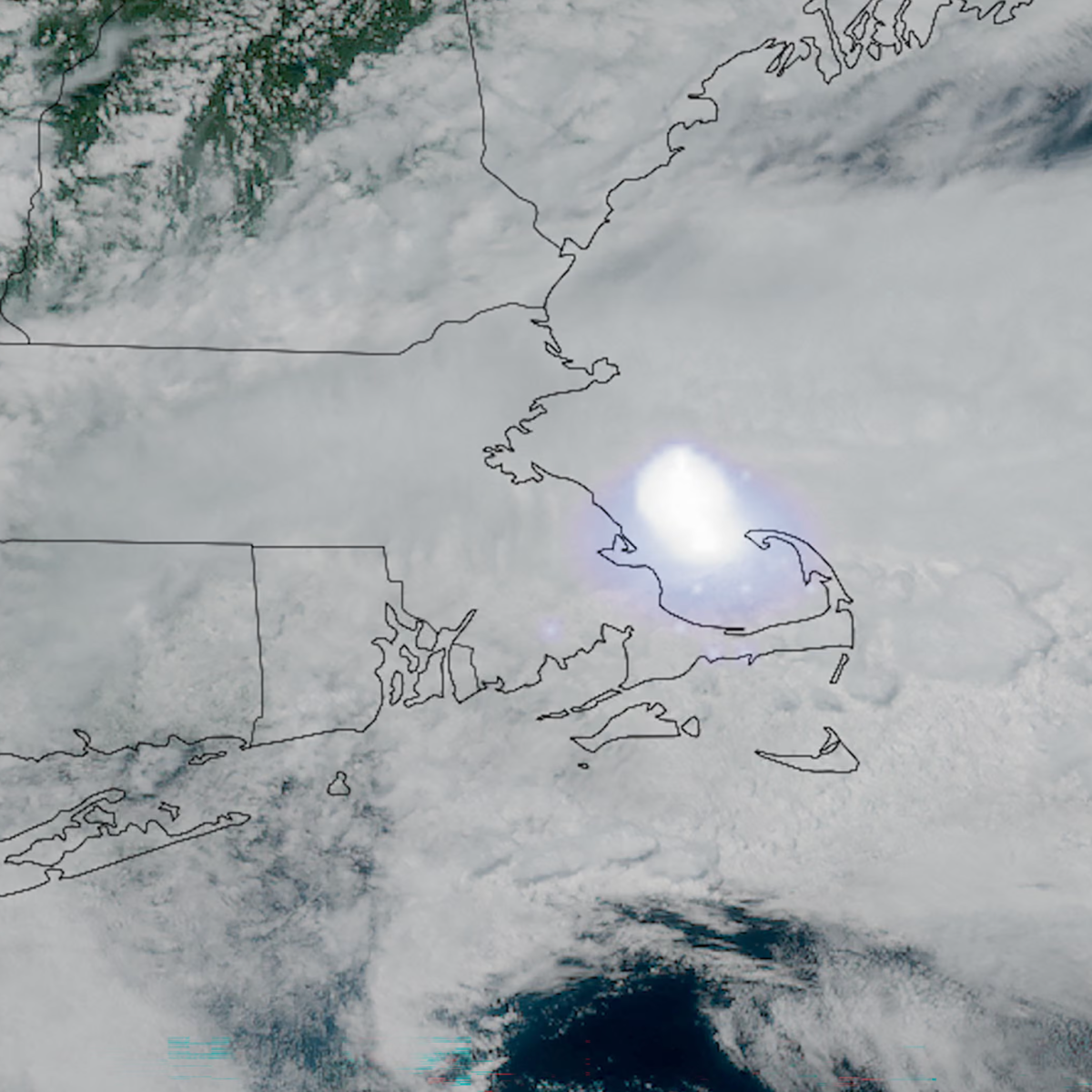
If you were outside at about 2:06 pm on Saturday, May 30th, you might have heard a loud boom erupting from the sky. Some described it as a ground-shaking earthquake, or others said they were certain a tree had fallen onto their house.
What was the real cause of this noise? A 5-foot-wide meteor entering the atmosphere over Massachusetts. The sound was heard from Montreal to Delaware and was accompanied by a “fireball” streak across the sky, which many described as a shooting star in daylight.
The meteor likely shattered around 31 miles above the ground and was probably moving at about 42,000mph. For reference, the speed of sound is about 767 miles per hour. When an object such as a meteor moves through the atmosphere faster than the speed of sound, it ends up “outrunning” its rippling sound waves. As a result, the waves literally pile up and compress in front of the object. This piling up of pressure creates a massive, cone-shaped shock wave known as a Mach cone that trails behind the projectile. When this meteor flies overhead and observers on the ground pass through the edge of its trailing cone, the sudden change in air pressure creates a loud, explosive thunderclap called a sonic boom.
In addition to this sonic boom effect, there was a second boom created by the explosion of the meteor itself. As the object plunged into the denser layers of Earth’s atmosphere, it was subjected to intense friction and thermal pressure. This extreme stress caused the meteor to abruptly fracture in a process known as an airburst. This sudden release of immense amounts of kinetic energy created its own independent, omnidirectional supersonic blast wave. The total energy unleashed by the meteor when it blew up was equivalent to about 300 tons of TNT, according to NASA.
The combination of the sonic boom and the supersonic blast wave resulted in many observers hearing a “double boom,” or two successive booms. Events like this meteor boom only happen about once or twice a year somewhere on Earth. However, because 70% of the Earth is covered by ocean and large stretches of land are uninhabited, most of these impacts go unnoticed by humans. Having one happen over a highly populated area like the U.S. Northeast is an incredibly rare, “once-in-a-few-decades” event for that specific region.
So the next time you hear a big boom, it might be the next meteor, or maybe just a thunderstorm outside. Either way, it’s nice to appreciate the natural wonders all around us.