Every March, Women’s History Month is celebrated to recognize women, their achievements, and their struggles. Recently, I was able to speak with advisor Sage Engberg and student leader Josh Sajan from an LS club with a similar focus, Students Together Empowering Women (STEW). We discussed STEW’s many achievements throughout the year. They also explained how they are recognizing Women’s History Month, as well as why STEW’s work is so necessary.
One of STEW’s recent focuses was advocacy during National Domestic Violence Awareness month in October. They hosted a bake sale with the proceeds going towards organizations that benefit women. To further spread awareness, they put posters up around the school and organized to light LS with the representative color of purple.
STEW also partnered with the LS Musician’s Union for a concert; they donated over $1500 towards Rosie’s Place. This is a shelter in Boston which helps women who have been impacted by homelessness.
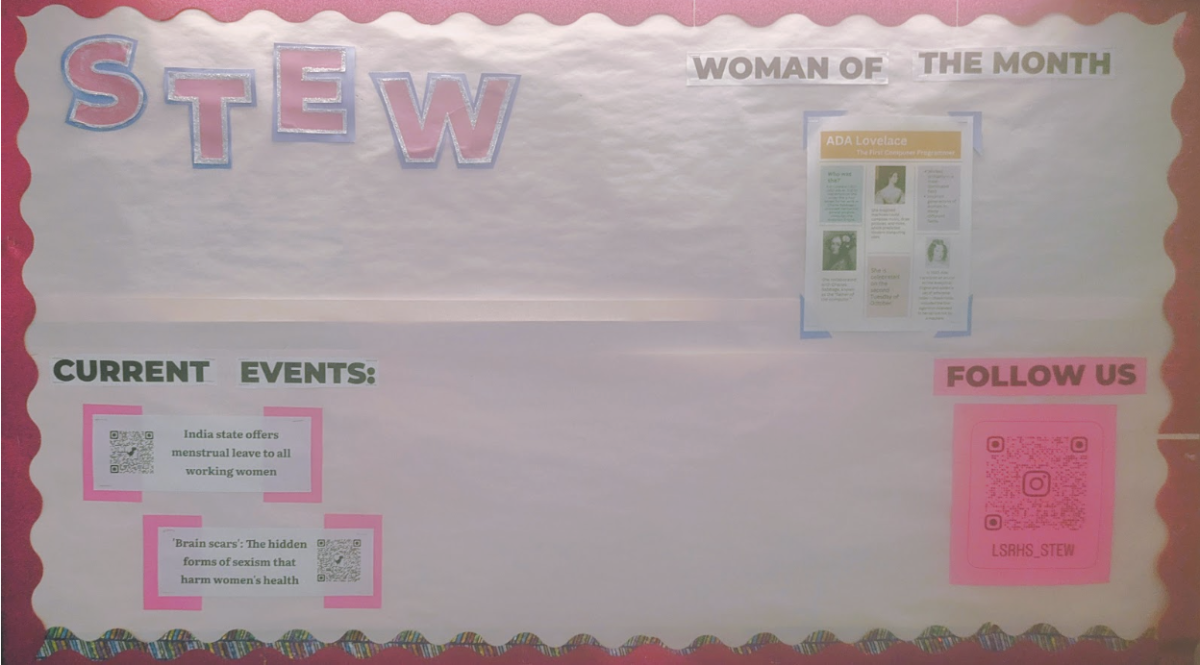
In celebration of Women’s History Month, STEW has placed emphasis on sharing the stories of the many influential women, past and present, who have not been previously recognized. Every day, STEW creates a daily slide about a different woman who has impacted history. They have highlighted a variety of activists, artists, musicians, and more.
This month, STEW also hosted a Fun Friday event. This included trivia questions; posters where students could write the names of inspirational women; and small games such as Guess Who with famous women from history.
Additionally, STEW organized a movie night at Goodnow Library. The film Hidden Figures was shown “in recognition of Women’s History Month and women’s stories that have been left out from history,” according to Ms. Engberg.
Recently, one of STEW’s major accomplishments was getting a Women’s Literature class approved at LS. Sajan, alongside fellow student leader Julie Seignemartin, first shared this idea; STEW was happy to carry out the initiative.
Club members created a slideshow with their plans for the class, which Ms. Engberg, an English teacher, helped them present to Ms. Weiss, the department coordinator. Ms. Engberg describes the presentation: “[STEW] looked into other schools in the area who offer [similar courses], we did a survey of students to see if there was interest in the course, we looked at curriculum for other women’s literature courses. It was really well-researched.”
The following spring, Ms. Engberg and her colleague, Ms. Garfield, presented to the English department. There was some controversy about the course. However, Ms. Engberg believes that, due to the depth in women’s history that it allows for, offering the class is worth it.
The course is still in the process of being designed, and LS students can provide input on which topics it will cover. Overall, the class will definitely have a focus on intersectionality. It will examine how factors such as race and body type, in addition to gender, impact how women are treated by society. Ms. Engberg states that students will “have conversations about what happens when these things are deemed as ‘the other’ in society” and when multiple marginalized identities, such as being a woman and person of color, intersect. Novels that explore these themes, like The Bluest Eye by Toni Morrison, will be included in the curriculum.
So, why are STEW’s initiatives so important?
First of all, there has been a lack of recognition for women’s achievements. In the past few decades, there has been more education about women throughout history. Despite this, as Ms. Engberg states, this is only the “tip of the iceberg,” and many women are still largely unknown for their contributions.
Also, there has recently been a shift away from feminist attitudes. “Throughout the 2010s, we had a big rise in ‘The Future Is Female,’ ‘Girl Power,’ … and right now, in the right-wing, online spaces for men, there is a lot of backlash against women,” explains Ms. Engberg. According to the 2026 IPSOS International Women’s Day Report, nearly one third of Gen Z men believe that a woman should always obey her husband. This is higher than many previous generations; it demonstrates how online spaces have influenced young men to have more negative views towards women.
Despite the still-ongoing fight, women’s issues may be seen as resolved. According to the aforementioned IPSOS survey, 52% of participants, including 61% of Gen Z men, agree that “when it comes to giving women equal rights with men, things have gone far enough.” However, as Sajan states, “We’re still fighting for women’s liberation now. I think we treat these issues like they’re some old thing that everyone has already talked about,” though important strides towards women’s equality, such as the right to vote and even own a credit card, have only been made fairly recently.
Even at LS, Sajan has noticed biases against female athletes. There has been a general sentiment from those who Sajan has spoken to that male athletes look down on them. “A lot of [female] athletes feel the weight of games not being perceived the same way,” he says. He cites how the girls’ rugby team does not receive much attention despite placing higher than the boys’ team.
What work does STEW hope to do to further combat this gender inequality?
Addressing inequity in sports at LS is one of STEW’s upcoming goals. Additionally, STEW is in the process of developing an advisory activity about Women’s History Month. Overall, through these efforts, STEW wants to educate young men to be “better informed about issues that women have historically faced in our society,” says Ms. Engberg.
There is certainly still a lot of work to be done towards achieving women’s equality at LS and in the world, though STEW has already made important progress.